The Auburn Disclosure Nobody Signs, and the Permit That Asks for It Instead
August 13, 2026
August 13, 2026
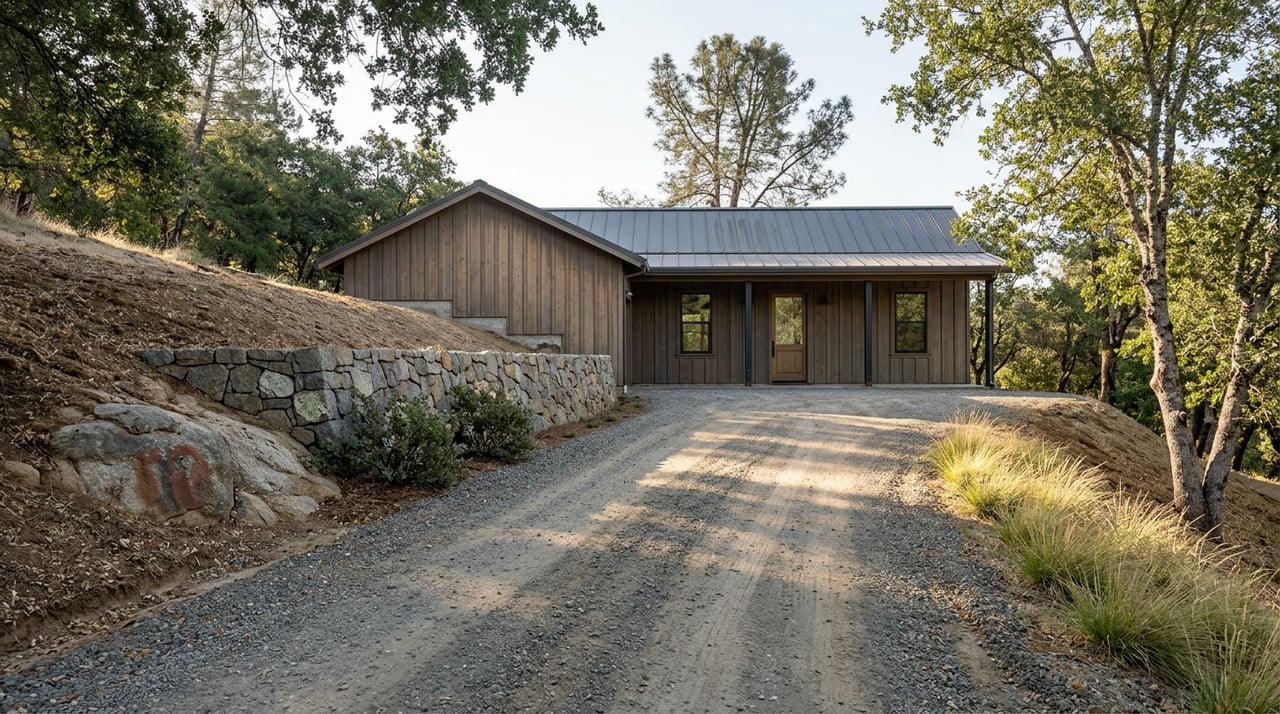
Say you just closed on two and a half acres off one of the ridge roads north of town. Nothing on your Transfer Disclosure Statement mentioned asbestos, because nothing on it triggered a yes. Six months later your contractor calls to say the county wants an Asbestos Dust Mitigation Plan before he can grade the driveway pad. That form never crossed your desk at the title company, and now it's holding up your project.
That gap, between a closing that stays quiet and a permit application that doesn't, is the real story behind naturally occurring asbestos in Auburn. It's a detail that rarely comes up during a purchase and almost always comes up later, when it's less convenient to learn about it for the first time.
Naturally occurring asbestos is exactly what it sounds like: a mineral that forms in certain rock types rather than something manufactured and installed in a house. According to Placer County, naturally occurring asbestos may be found in at least 44 of California's 58 counties, most often in serpentine and ultramafic rock formations. The foothill terrain around Auburn sits squarely in that geology.
The county's own language is worth sitting with, because it's calmer than most people expect: the material itself isn't automatically a problem. The hazard shows up when it's disturbed. As Placer County puts it, when naturally occurring asbestos-containing material is disturbed, fibers can become airborne and create a potential health hazard. Left alone in the ground, it's inert. Graded, excavated, or crushed for a driveway base, it becomes something else.
That distinction is why the county doesn't treat this as a blanket warning about every Auburn property. It treats it as a mapping and permitting question tied to specific parcels and specific projects. The California Geological Survey produced a dedicated report, Special Report 190, assessing the relative likelihood of naturally occurring asbestos across Placer County. From that report, the Placer County Air Pollution Control District built area-specific hazard maps, and they didn't lump the whole county together. There's a separate map for North Auburn and Vicinity, a separate one for South Auburn and Vicinity, and others for Colfax, Alta, and Foresthill. If you're buying or building in the Auburn area, your parcel falls on one of these two specific maps, not a generic countywide overlay.
Here's the part that catches people off guard. Placer County's asbestos framework isn't a disclosure question you answer during escrow. It's a permit requirement tied to how much ground you plan to disturb.
The county's rule is specific: if an area to be disturbed is greater than one acre, and the owner or operator is subject to the state's Asbestos Airborne Toxic Control Measure for construction, grading, quarrying, and surface mining, an Asbestos Dust Mitigation Plan has to be submitted to the Air Pollution Control Officer before that work begins. That threshold, one acre, is the line. Cross it in a mapped area and the paperwork becomes mandatory. Stay under it and the question may never come up at all.
On a lot in Old Town, that line is rarely relevant. On acreage outside the historic core, where Auburn buyers often go for larger parcels and more room, it's easy to cross without meaning to. A new driveway cut into a sloped lot, a septic leach field replacement, pad grading for a shop or a barn, an access road cut to reach a well site: any of these can move enough native soil to approach or pass an acre, depending on the parcel's shape and grade. None of that shows up on a standard purchase contract. It shows up when someone applies for a grading or building permit and the county checks the parcel against its NOA maps.
What makes this worth understanding before you buy, rather than after, is what happens one county over. El Dorado County sits on similar serpentine geology, and it handles the same underlying hazard through an entirely different mechanism.
| Placer County (Auburn) | El Dorado County | |
|---|---|---|
| Mechanism | Air district permit requirement | Seller-signed disclosure addendum |
| When it surfaces | At the grading or building permit stage, if disturbance exceeds one acre in a mapped zone | Before closing, as part of standard transfer paperwork |
| Who completes it | Property owner or contractor, through the permit process | Seller, as part of the transaction |
El Dorado County requires sellers to answer specific questions directly on a local disclosure form: whether naturally occurring asbestos on the property has been disturbed, whether a geologic evaluation was performed by a Registered Geologist qualified to assess NOA, and whether any aggregate material imported to the property after June 12, 2003 contains more than 0.25 percent naturally occurring asbestos. A buyer in El Dorado County sees this question in writing, with a seller's signature attached, before the sale closes.
A buyer in Auburn doesn't get that document, because Placer County doesn't require one. That's not a gap in the law. It's a different design. Placer's system assumes the hazard matters at the point of disturbance, not at the point of sale, so it puts the obligation on whoever pulls the permit rather than on the seller at closing. The practical effect is the same underlying rock, but a completely different paper trail, and a completely different moment when the question actually gets asked.
If you're under contract on a rural or semi-rural Auburn parcel and you have any plans, even loose ones, to grade, build, add a structure, or put in new site infrastructure, it's worth checking your specific address against the North Auburn and South Auburn NOA hazard maps before you finalize those plans. That's a five-minute check that tells you whether your parcel sits in a mapped area at all.
If it does, and your project is likely to disturb more than an acre, build the Asbestos Dust Mitigation Plan into your timeline the way you'd build in a well test or a septic inspection. It gets submitted to the county before work starts, not after equipment is already on site. Contractors who work regularly in the Auburn foothills are usually familiar with the process, but it's worth asking directly, before you're locked into a construction schedule that assumes it doesn't apply.
None of this changes what the statewide Transfer Disclosure Statement already requires. California's Department of Real Estate lists asbestos among the environmental hazards a seller must disclose if they're aware of it, the same as radon, lead paint, or contaminated soil. That obligation exists everywhere in the state and covers what a seller actually knows about their own property. The Placer County NOA framework is a separate, parallel system, tied to geology and construction activity rather than seller knowledge, and it's the one that tends to surprise people because it doesn't announce itself until later.
Does this apply if I'm buying a small lot in Old Town Auburn? Check the map for your specific address rather than assuming. The North Auburn and South Auburn maps cover different geographic areas within the city and surrounding vicinity, and lot size alone doesn't tell you which zone you're in.
If I'm not planning to build or grade anything, does this ever come up? Usually not right away. The Asbestos Dust Mitigation Plan requirement is tied to a permit application for qualifying disturbance. If your plans stay below the one-acre threshold, or you never pull a grading permit, the question may simply never arise for your property.
Is this the same as the asbestos disclosure on the standard TDS form? No. The statewide Transfer Disclosure Statement asks whether the seller knows of asbestos as a material defect, similar to how it treats other environmental hazards. Placer County's NOA program is a separate, geology-based framework administered by the county's air district, tied to construction activity rather than a seller's personal knowledge.
Rural and semi-rural Auburn properties come with this kind of layered detail more often than a standard suburban listing, and it's exactly the sort of thing that's easy to miss if nobody's looking for it early. Sarah Stone-Francisco and Gabi Biase spend a good part of their work on acreage and custom-property transactions across the foothills, checking details like this before they become a delay instead of a line item. If you're weighing a purchase or a sale on Auburn acreage and want a clear-eyed read on what's ahead, Let's Connect.


Enjoy attentive service, thoughtful guidance, and a detail-oriented approach designed to help you achieve your real estate goals.